Manual Ops Instructions are where agility goes to die. We have all seen them. The five-page document guides. The step-by-step promotion rituals. The "do not forget Step 2" warnings. If your deployment process depends on a human following a checklist, you are not scaling; you are just surviving.
The Death of Agility in Ops Instructions#
Promoting a simple feature to Production should be a non-event. In many MuleSoft environments, it is a high-stakes ceremony. You start with Step 1: Create the Anypoint MQ queue. Then Step 2: Apply the Client ID Enforcement policy. You move to Step 3: Update the API Instance version. By Step 4, you are just hoping you didn't miss Step 2.
In a Brownfield project, these manual steps are more than just slow. They are a security and reliability risk. One missed click in the Anypoint Platform UI creates a snowflake environment. You end up with a configuration that exists in Production but cannot be easily replicated in SIT or UAT. This lack of parity leads to "it worked in Dev" bugs that only appear during the final release.
The Fragility of Custom Scripts
Many teams try to solve this by writing custom shell scripts for the Anypoint CLI. This creates a new problem. Maintaining these scripts becomes a full-time job.
- Scripts are fragile: They break when APIs change or when environment variables are slightly off.
- Logic is hidden: Complexity is buried in layers of if-else statements.
- Partial failures: If a script fails halfway through, you are left with a half-configured environment.
Manual promotion relies on human memory. You have to remember that Exchange needs the Asset before the API Manager can see it. You have to remember which Business Group owns which resource. This is not a scalable way to manage an enterprise integration platform.
The Shift to Terraform: Managing a State of Truth#
The alternative is to stop treating platform configuration like a one-off task. You must start treating it like source code. This is where Infrastructure as Code (IaC) via Terraform changes the daily workflow.
Instead of a checklist of actions, you manage a state of truth. You define what the environment should look like. You update the code and let the Terraform provider handle the how.
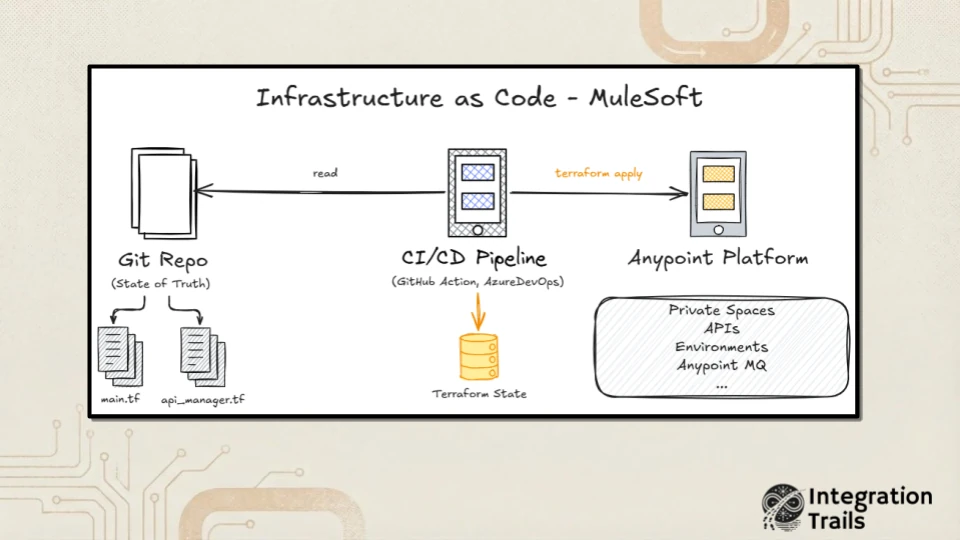
Why This Changes Your Daily Workflow
When you adopt Terraform for MuleSoft, your day-to-day operations transform. Consistency becomes the default. You ensure Dev, SIT, and Production are identical every single day. There is no guesswork about whether a specific policy was applied in the higher environments.
Auditability is built-in. Every change to your API instances, policies, or MQ queues is tracked in Git. You no longer wonder who changed the Client ID Enforcement settings at 3:00 AM. The commit history tells the story.
Recovery is simplified. If a configuration is accidentally deleted or corrupted, a single command restores it. Terraform compares the current live state against your code and fixes the discrepancies.
Automatic Dependency Detection: The Hidden Superpower#
The most frustrating part of manual platform management is managing dependencies. You cannot bind a queue to an exchange if the exchange doesn't exist. You cannot apply a policy to an API instance that hasn't been created yet. Terraform excels here because it understands the resource graph.
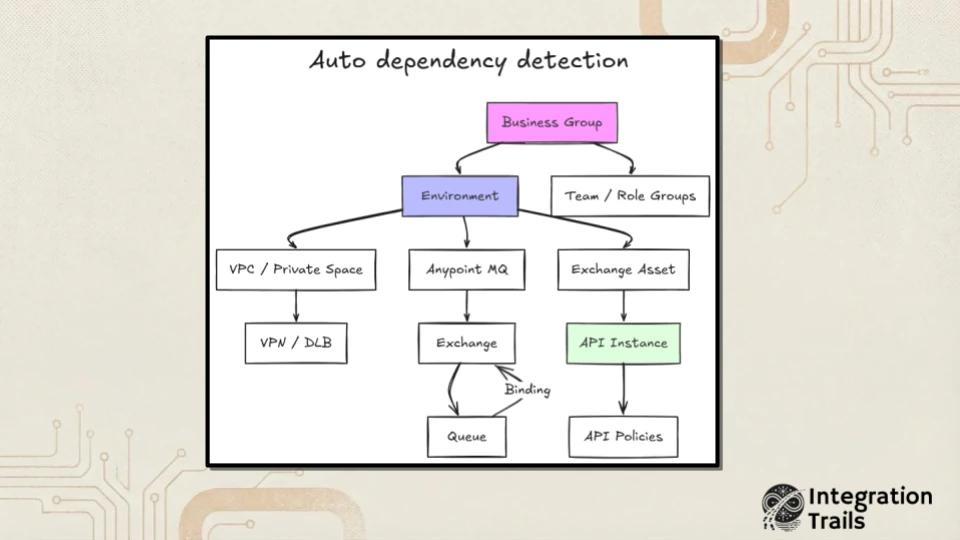
Understanding the Resource Hierarchy
In a typical MuleSoft environment, resources are deeply linked. Terraform handles the sequencing automatically, eliminating the order of operations errors that plague manual checklists.
Use Remote State
Always store your Terraform state files in a remote backend like AWS S3 or Azure Blob Storage. This prevents state drift and allows multiple team members to collaborate on infrastructure changes without overwriting each other's work.
Moving Beyond One-Off Tasks#
Platform configuration should not be a ticket-based manual task. It is a fundamental part of the Software Development Life Cycle (SDLC). When you shift to an automated approach, you free your architects and developers from the drudgery of UI navigation.
We need to stop accepting the status quo of "Ops Instructions." If a step can be written down in a document, it can be written in code. Code is repeatable. Code is testable. Documents are just evidence of a process that hasn't been automated yet.
Key Takeaways
- Eliminate Checklists: Manual instructions are a primary source of environment drift.
- Adopt IaC: Use Terraform to manage the Anypoint Platform as a state of truth.
- Leverage Dependencies: Automated tools understand resource relationships better than humans.
- Audit Everything: Keep your platform configuration in Git for a clear audit trail.
- Parity is Power: Ensure environments are identical to reduce Production-only bugs.