Production Ready MuleSoft training suggests using a Bill of Materials (BOM) to manage versions across an ecosystem. On paper, it looks like a perfect "parent to the parent-pom." In practice, for most enterprise projects, it is an idealistic trap.
BOMs often lead to update lag, circular logic, and unnecessary complexity. If you want a scalable architecture, stop over-engineering dependencies and start focusing on a robust Parent POM strategy.
The BOM Trap: Why Standard Advice Fails#
Standard advice often leads to a maintenance nightmare. When you use a BOM to manage every version, a simple connector update triggers a chain reaction. You update the BOM, then the Parent POM, and then every individual API. This is not efficiency. This is architectural debt.
If your dependency management makes a local build slower or a pipeline more fragile, it is failing. Instead of layering abstractions that break under pressure, move toward a correctly configured Parent POM. This shift replaces complex versioning hierarchies with a single, authoritative source of truth.
Decoupling the Pipeline: The "No-Go" Zone#
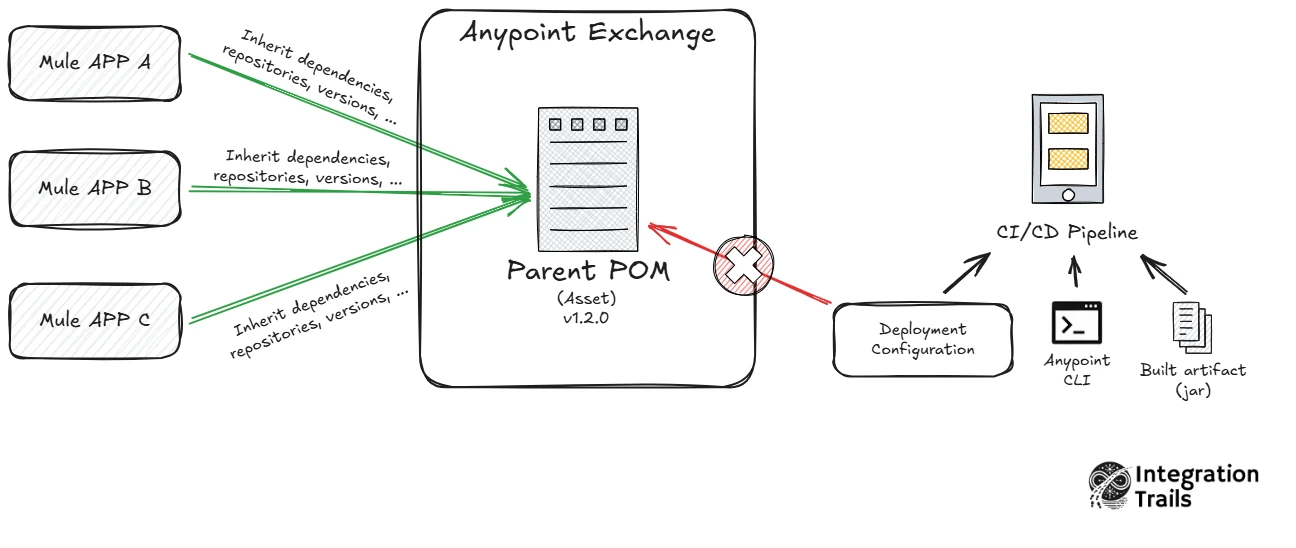
The biggest mistake architects make is mixing Build logic with Deployment logic. Maven is a build tool. It excels at managing repositories and locking plugin versions. It is notoriously fragile when used to manage environment-specific deployment configurations for CloudHub 2.0.
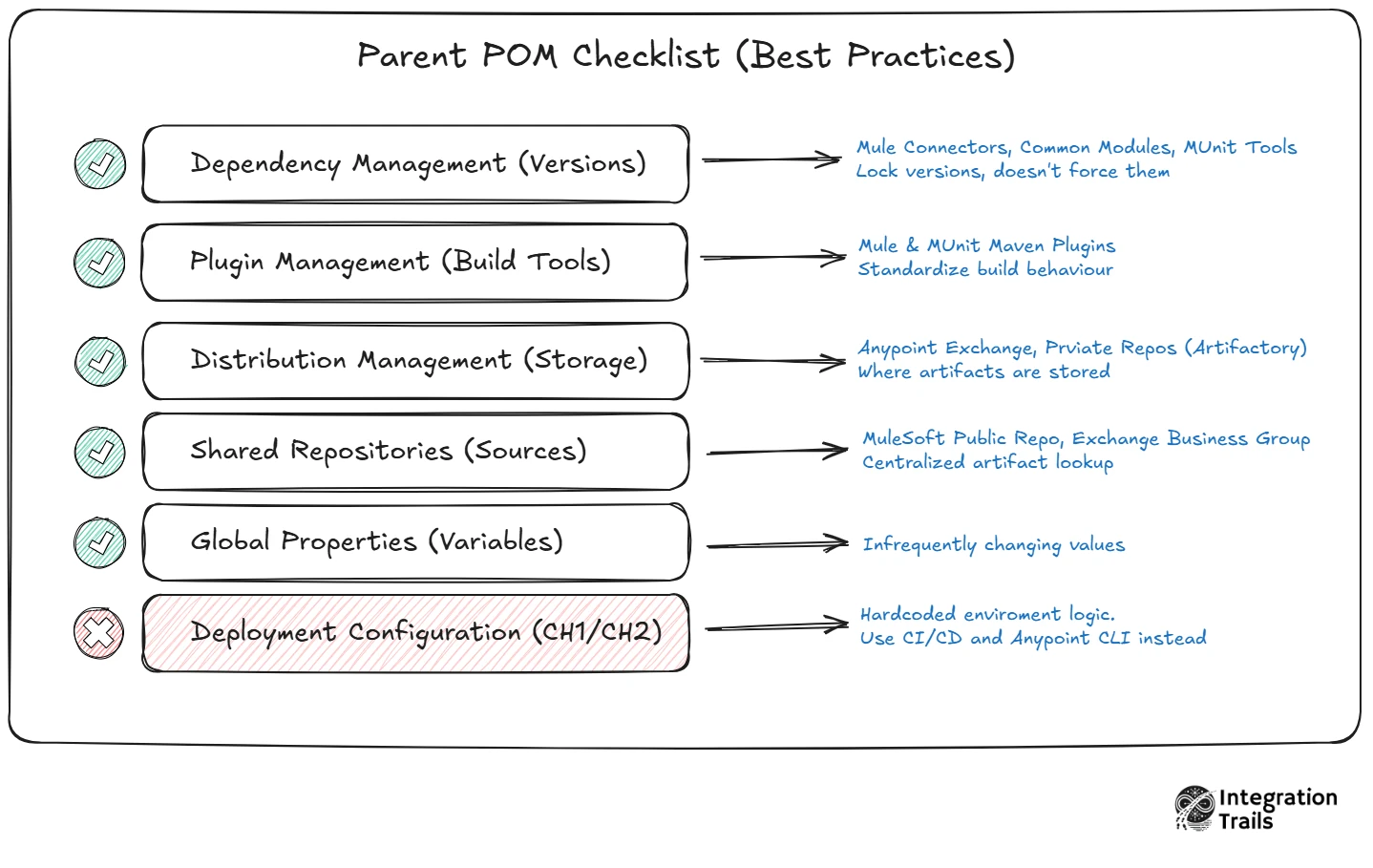
Do not put <cloudHubDeployment> or <cloudhub2Deployment> blocks in your Parent POM**
Maven is for building the artifact. Anypoint CLI is for deploying it. By using the CLI in your CI/CD pipeline, you decouple environment logic from code. This keeps your POM clean, your builds fast, and your deployment scripts easier to maintain.
Anatomy of a High-Performance Parent POM#
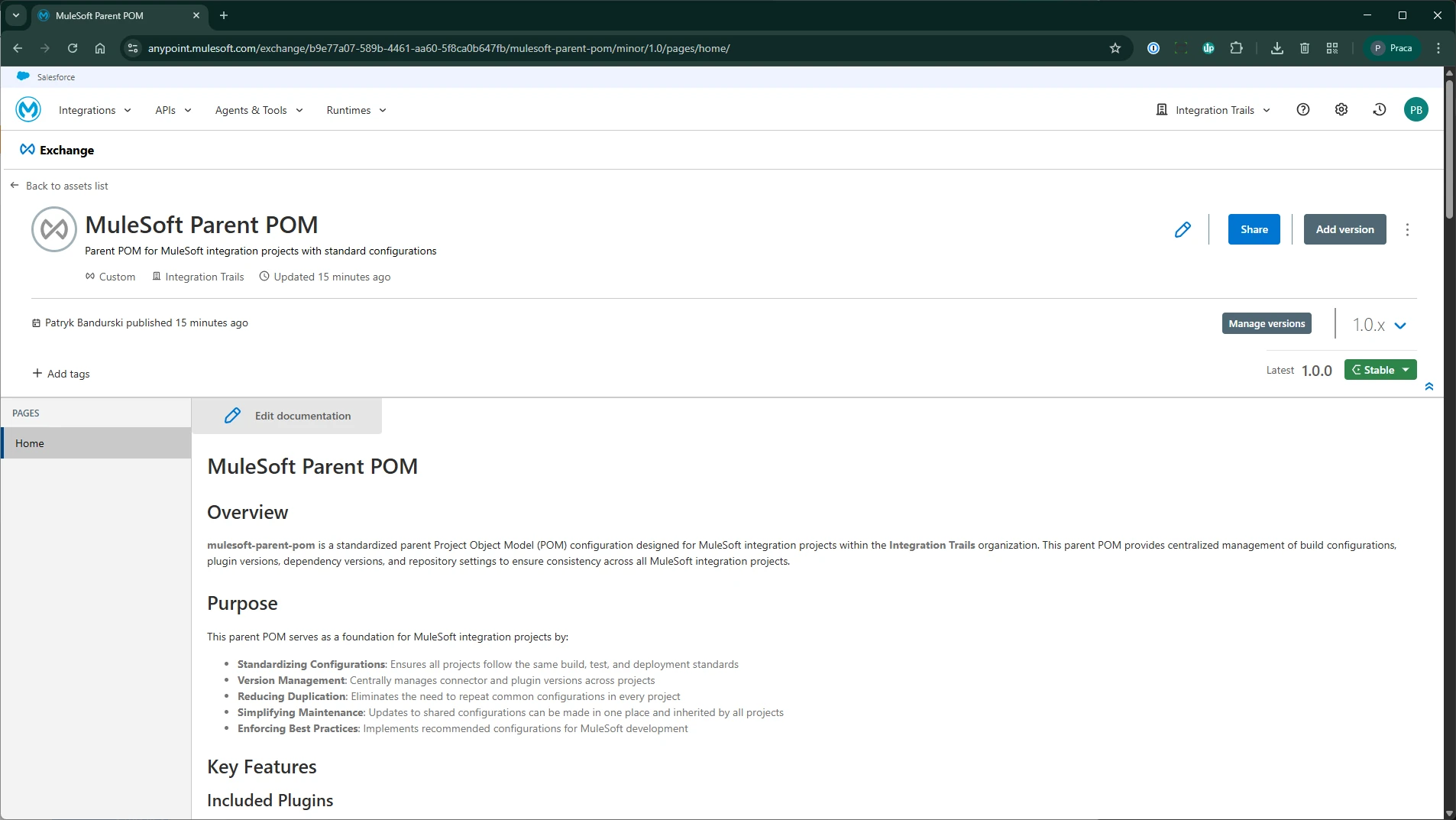
A Parent POM should be a Single Source of Truth that lives on Anypoint Exchange as an asset. It provides the foundation for every API in your ecosystem.
1. Global Properties
Define versions for connectors and plugins in the <properties> block. This allows organization-wide updates by changing a single value.
<properties>
    <mule.maven.plugin.version>4.6.0</mule.maven.plugin.version>
    <mule-http-connector-version>1.11.0</mule-http-connector-version>
</properties>
Why it helps: It eliminates version drift. Every team uses the same tested version of a connector.
2. Dependency Management
Use the <dependencyManagement> section to lock versions without forcing them onto every project.
<dependencyManagement>
    <dependencies>
        <dependency>
            <groupId>org.mule.connectors</groupId>
            <artifactId>mule-http-connector</artifactId>
            <version>${mule-http-connector-version}</version>
            <classifier>mule-plugin</classifier>
        </dependency>
    </dependencies>
</dependencyManagement>
Why it helps: Child APIs only inherit the version if they explicitly call the dependency. This prevents bloated artifacts while ensuring version compliance.
3. Plugin Management
Standardize build behavior by defining the mule-maven-plugin and munit-maven-plugin configurations.
<plugin>
    <groupId>org.mule.tools.maven</groupId>
    <artifactId>mule-maven-plugin</artifactId>
    <version>${mule.maven.plugin.version}</version>
    <extensions>true</extensions>
</plugin>
4. Shared Repositories
Centralize your <repositories>. Child projects should know where to find MuleSoft releases and Exchange assets without local configuration.
5. Distribution Management
The <distributionManagement> block tells Maven where to deploy your Parent POM-ideally your Organization Anypoint Exchange.
The Blueprint: Access the Battle-Tested Template#
Architecture is not about using every feature available; it is about choosing tools that survive production reality. This blueprint avoids the BOM nightmare and focuses on a lean, decoupled setup.
Access the Full Parent POM Gist here:
Exchange Documentation
Treat your Parent POM as a product. Document available properties and connector versions on the Anypoint Exchange asset page. This makes it easier for developers to know what they inherit.
Key Takeaways
- Kill the BOM: A Parent POM is more maintainable for most enterprise projects.
- Separate Concerns: Maven builds the JAR. Anypoint CLI handles the environment.
- Exchange is the Hub: Host your Parent POM on Anypoint Exchange for visibility and reuse.
- Governance via Properties: Use <dependencyManagement> to prevent version drift across teams.