RAML-first is a legacy mindset. If you architect MuleSoft ecosystems without an OpenAPI Specification focus, you are building for the past. The shift to OAS 3.x is the backbone of modern interoperability. It is no longer about a file format. It is about building a machine-readable ecosystem.
The Shift to Global Interoperability#
Modern architecture requires your APIs to scale across the entire IT landscape. Sticking to RAML creates technical friction. It isolates your assets. It increases Mule-lock-in. Most modern platforms like AWS, Azure, and Postman treat OAS as the primary language.
Using OAS ensures your developers speak the industry standard. It reduces the learning curve for new team members. It simplifies integration with third-party tools. You must stop building isolated APIs. Start building services that the rest of the world understands.
Building a Scalable Common Data Model (CDM)#
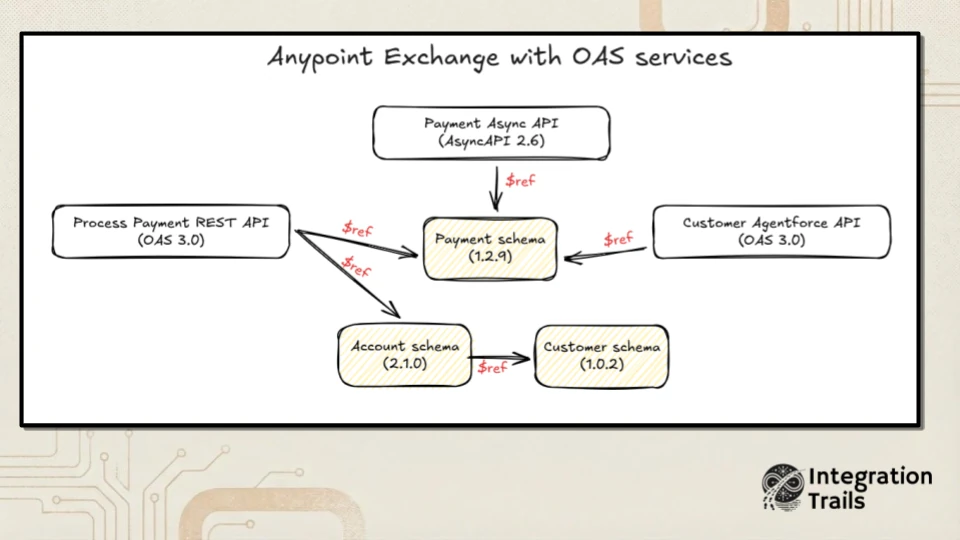
Effective architecture requires a Common Data Model (CDM). You must define data structures once and reuse them everywhere. Use JSON Schema fragments in the Design Center as your gold standard. These fragments act as the source of truth for your data objects.
Why JSON Schema Wins
JSON Schema allows you to reference objects across different protocols. You can use the same Customer
object for a REST call and an AsyncAPI message. This creates a unified experience for developers. It ensures consistency across your entire platform.
- Reliability: Changes to the schema propagate through all linked assets.
- Speed: Generating specs is faster due to mature third-party ecosystems.
- Scalability: Reference fragments across multiple Business Groups.
Decouple Your Fragments
Store your JSON Schema fragments in a separate, version-controlled Exchange asset. This allows multiple API specifications to reference a single source of truth without duplicating code.
OAS as Your Runtime Firewall#
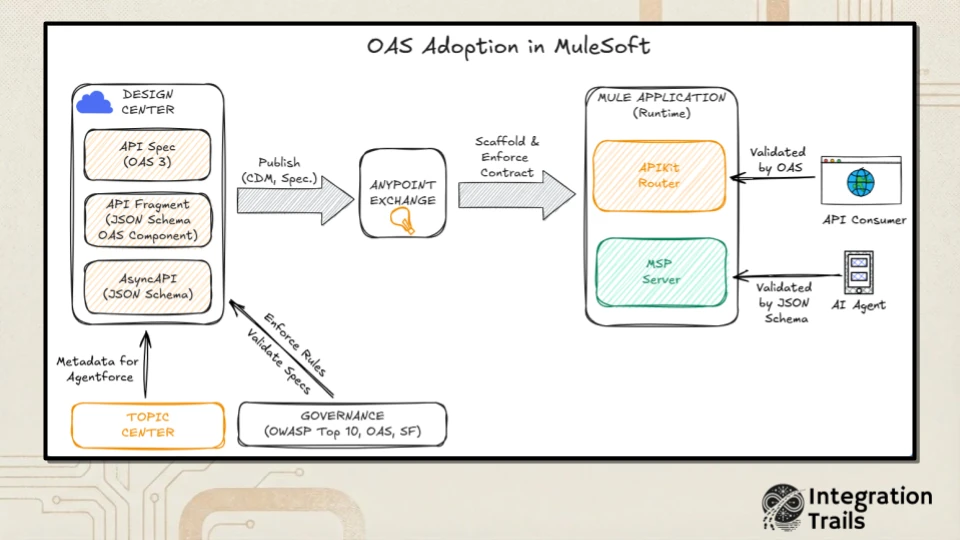
Your API specification should protect your environment. Do not treat the spec as passive documentation. Enable request validation in the APIkit Router. This turns your OAS into a runtime firewall. It automatically rejects malformed data before it reaches your backend logic.
This approach ensures only valid data enters your system. It reduces the amount of manual error-handling code you need to write. It enforces your contract at the gateway level. This is a direct, actionable way to increase system reliability and security.
AI Readiness and the Agent Era#
We have entered the era of AI Agents. To participate, your APIs must be Agent-ready.
MCP Services use schemas to expose tools to AI. If your schemas are non-standard, AI cannot utilize them. Machine-readable specs are the only way to expose capabilities to modern LLMs.
Discovery and the Topic Center
Use Anypoint Exchange to make your technical assets discoverable. AI Agents look for standardized documentation to understand how to interact with services. OAS provides the metadata necessary for tools like Agentforce to function. Without standardized specs, your APIs stay hidden in the shadows.
Automated Governance#
Architecture without governance is chaos. You must enforce standards early in the lifecycle. Automated governance allows you to enforce OWASP standards and naming conventions at design-time. This happens before a single line of code is written. Every change is tracked. Vulnerabilities are detected early. It ensures your platform remains a modern asset, not a technical debt factory.
Key Takeaways
- Abandon RAML: OAS 3.x is the requirement for modern interoperability.
- Standardize Data: Use JSON Schema fragments for a cross-protocol Common Data Model.
- Automate Security: Use APIkit request validation as a runtime firewall.
- Prepare for AI: Machine-readable specs are mandatory for AI Agents and MCP Services.
- Reduce Lock-in: Use global standards to ensure compatibility with the broader IT landscape.