Hey there, tech enthusiast!
Do you want to stay updated with the latest tech that actually helps you elevate your skills and career? Then get ready to discover the Model Context Protocol (MCP)! At Integration Trails, we're all about giving you practical, cutting-edge knowledge you can use right now. And believe us, MCP is the game-changer you've been waiting for in AI integration!
So, What Exactly is MCP?#
Imagine a world where your AI applications can effortlessly connect and use any tool or data source out there, without needing a deep dive into complex API documentation every single time. Sounds like a dream, right? Well, that dream is now a reality thanks to MCP!
MCP is a revolutionary, relatively new protocol designed to enable AI agents and applications to seamlessly, easily, and securely consume specific data sources or utilize various tools. Think of it as the ultimate translator that allows AI to speak the language of any tool.
Here's the magic: With traditional REST APIs, your AI application would need to understand the unique schema and intricacies of each individual tool's API. This can be a huge headache, leading to complexity and potential errors. MCP flips that on its head! It abstracts away all that complexity, meaning your AI agent doesn't need any internal knowledge of how to consume a tool. The main idea? It makes plugging in discrete, easily written tools incredibly simple.
The Brains Behind the Operation: MCP Architecture#
Let's peek under the hood. MCP involves a few key players:
- AI-Powered Application (AI Agent): This is your smart AI, like ChatGPT, that wants to get things done.
- MCP Client: This acts as the AI agent's dedicated messenger.
- MCP Server: This is where your tools, resources, and capabilities live.
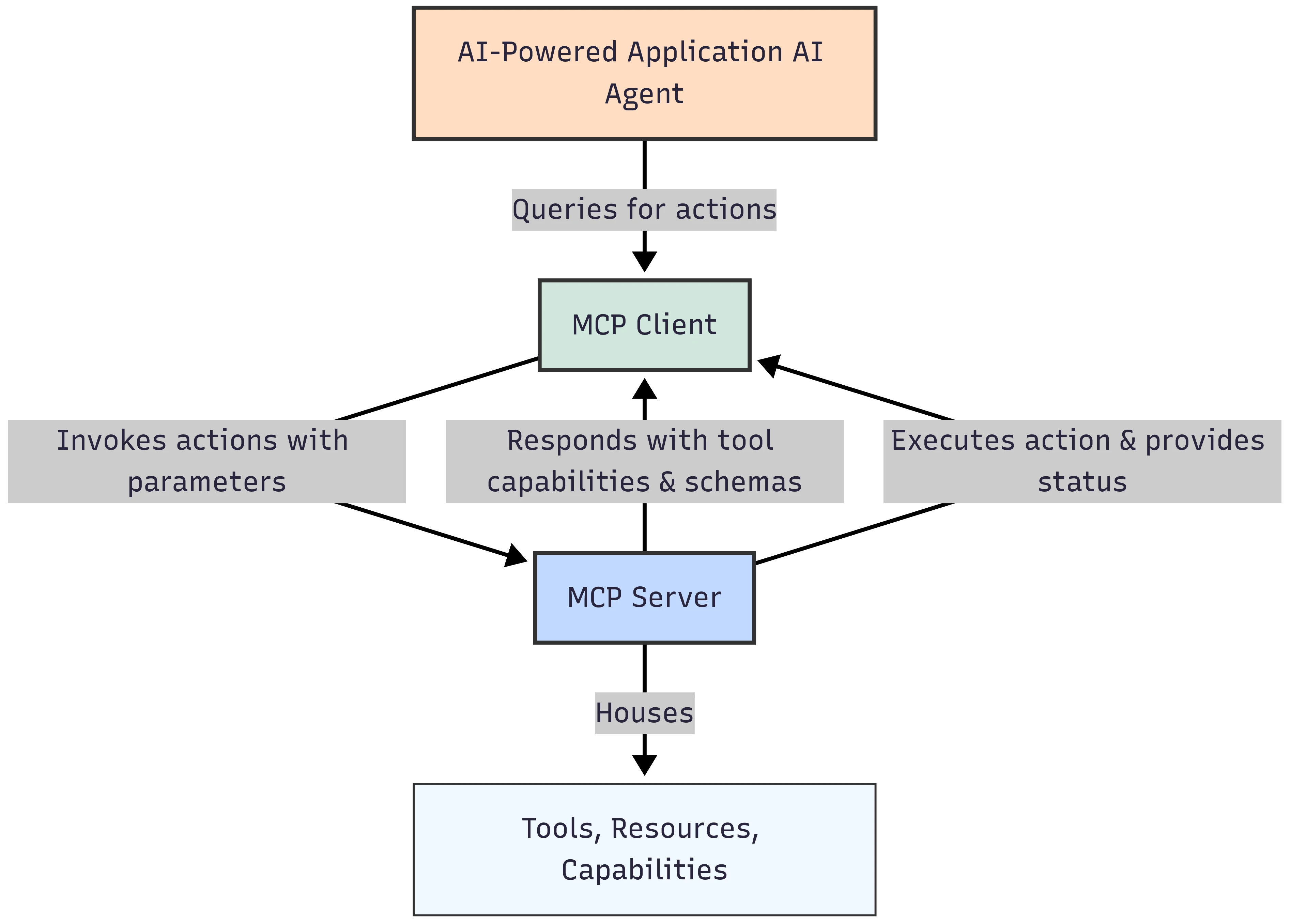
The connection between the MCP Client and MCP Server is a direct, one-to-one link. However, your AI agent can have multiple MCP Clients, each connecting to different MCP Servers, which in turn represent a vast array of tools and resources.
One of the coolest features of the MCP Client is its powerful ability to query and understand what capabilities the MCP Server offers. It's like asking, "Hey, what can you do for me?" And the MCP Server responds by listing specific tools it provides – perhaps a Mulesoft API endpoint, or even CLI actions like publishing an API or redeploying an application!
How AI Agents Get Things Done with MCP#
This is where it gets really exciting!
- Querying for Tools: Your AI agent, through its MCP Client, simply asks the MCP Server what actions it can perform. For example, the MCP Server might respond, "I can restart an application for you if you provide the name, and I'll tell you the restart status."
- Invoking Actions: Once the AI agent knows what's possible, it uses the MCP Client to invoke those actions. The beauty is that the MCP Server provides the exact input and output schemas, so the AI agent knows precisely what parameters to send.
Let's imagine a real-world scenario:
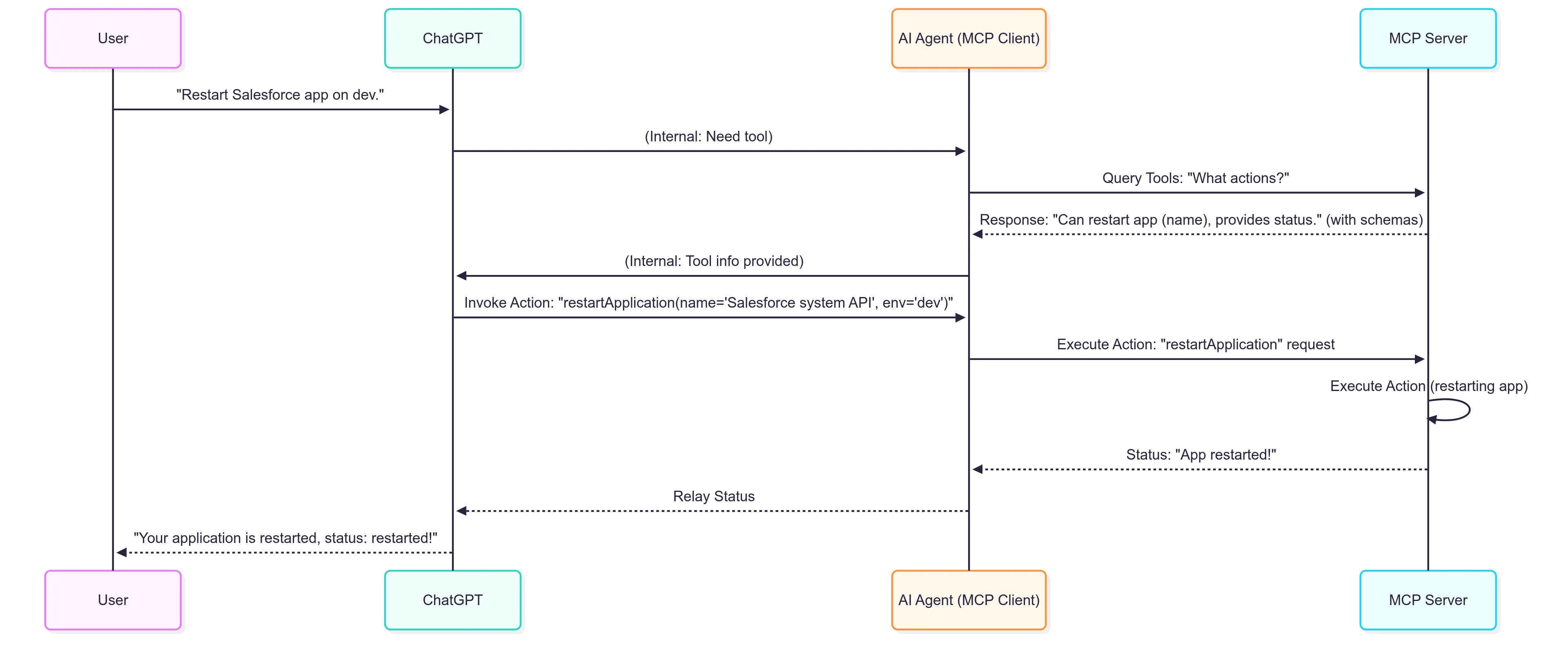
You're talking to ChatGPT and you say, "I need to restart the Salesforce system API application on the dev environment."
- The MCP Client springs into action, providing the AI agent with the information on how it can perform this very task.
- The AI agent, leveraging its powerful language model capabilities, constructs the request with the necessary parameters.
- The MCP Server receives the request, executes the action (restarting your application!), and provides a status update back to the AI agent.
- "Your application is restarted, status: restarted!" – Just like that!
Why MCP is a Game-Changer You Can't Ignore#
MCP isn't just a concept; it's already widely adopted! There are literally hundreds, even thousands, of MCP Servers already out there. From web scraping to CI/CD tooling, streamlining QA processes, or even interacting with Git for pushing commits – the use cases are boundless!
And here's another reason to be enthusiastic: it's surprisingly easy to develop with! In Python, you can set up an MCP Server with just a few lines of code. While Mulesoft support is emerging, the potential for integrating MCP with various platforms is immense.
So, why should YOU invest your time in learning MCP?
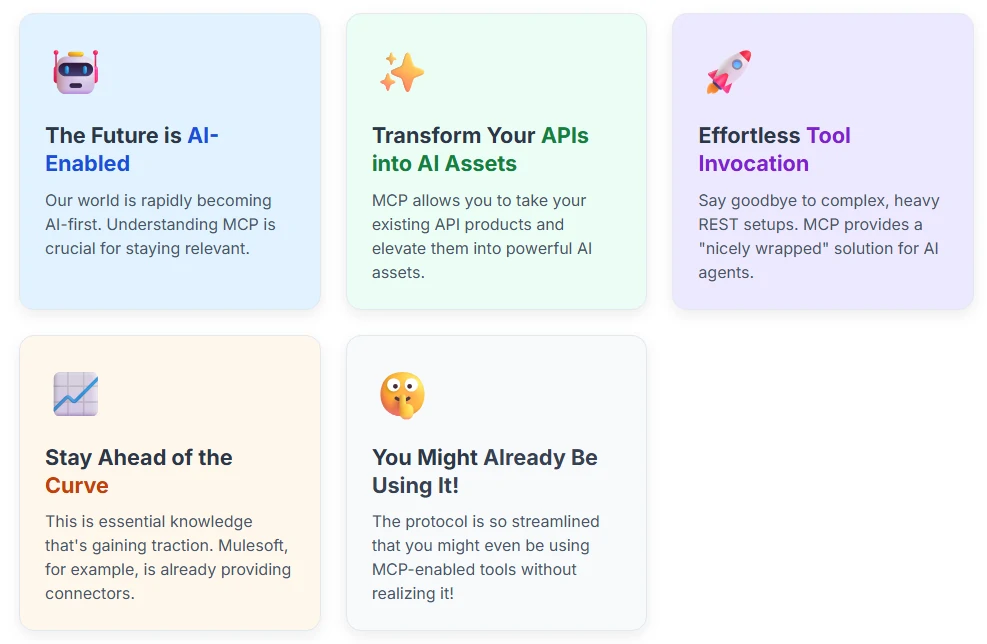
- The Future is AI-Enabled: Our world is rapidly becoming AI-first. Understanding MCP is crucial for staying relevant. Transform Your APIs into AI Assets: MCP allows you to take your existing API products and elevate them into powerful AI assets.
- Effortless Tool Invocation: Say goodbye to complex, heavy REST setups. MCP provides a "nicely wrapped" solution that makes it incredibly easy for AI agents to invoke tools.
- Stay Ahead of the Curve: This is essential knowledge that's gaining traction. Mulesoft, for example, is already providing connectors.
- You Might Already Be Using It! The protocol is so streamlined that you might even be using MCP-enabled tools without realizing it!
The Model Context Protocol is not just another buzzword; it's a fundamental shift in how AI interacts with the digital world. By understanding MCP, you're not just learning a protocol; you're future-proofing your career and unlocking a whole new level of capability for AI integration. Get ready to supercharge your skills – the MCP revolution is here!
Ready to dive deeper and master MCP? Here are some excellent resources to continue your learning journey:
-
The Official Model Context Protocol Page: For a comprehensive introduction and ongoing updates, explore the dedicated website.
-
O'Reilly Online Courses: For a more structured learning experience, consider these insightful 4-hour courses:
- Model Context Protocol (MCP) for Software Engineers by Sergio Pereira
- Building AI Agents with Model Context Protocol (MCP) by Lucas Soares
These resources will provide you with an even broader perspective and practical knowledge to supercharge your skills in the MCP revolution!